
Corporate Operating Plan 2026
Update Dec. 18, 2025
At their monthly meeting this evening, the Omaha Public Power District Board of Directors approved the utility's $2.98 billion Corporate Operating Plan for 2026. It will raise rates by an average of 6.3% across all customer classes.
Key drivers for the adjustments include increased net power costs (fuel and purchased power), rising capital investments to maintain system reliability and sharply escalating costs for essential utility materials. Additionally, OPPD must bolster its reserve energy margins, above and beyond what our customers use at peak times, to meet the new requirements of the Southwest Power Pool (SPP), its regional transmission organization. Higher reserve margins are designed to help ensure system reliability.
The budget, effective Jan. 1, includes a 5.8% general rate increase and a 0.5% increase to the Fuel and Purchased Power Adjustment (FPPA, a line item on customer bills that addresses changing fuel and purchased power costs outside of the utility’s control. Even with this adjustment, OPPD’s rates are 30% below the national average, according to the Energy Information Administration.
- Residential customer rates will increase by 6%
- Average bill of $115 would go up by about $7 a month
- Commercial customer bills rates will increase by an average of 3.7%
- Industrial customer bills rates will increase by an average of 8.9%
To help mitigate a rate increase in 2026, OPPD reduced internal costs in 2025 by nearly $60 million, including a hiring freeze for non-critical roles and deferring or canceling projects. For context, $60 million in cost savings roughly equates to an additional 4% in avoided rate increases.
The 2026 budget includes essential projects that directly affect customer service and system performance, such as generation additions, transmission and distribution upgrades and infrastructure hardening to protect against severe weather. It also includes the installation of more automated metering infrastructure and technology upgrades to improve customer service.
Customers struggling with their utility bills are encouraged to contact OPPD at 402-536-4131 or 1-877-536-4131 (outside of the Omaha calling area) for assistance.
For more information, see this story in The Wire.
Preliminary Corporate Operating Plan
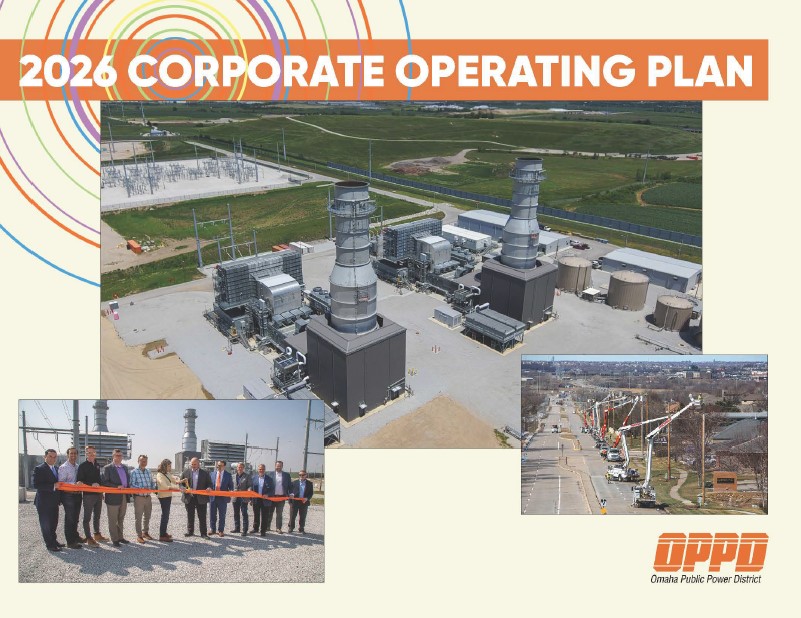
OPPD has released its preliminary 2026 Corporate Operating Plan (COP). The COP lays out OPPD's proposed budget for 2026 and provides customers and interested partners with insight into the utility’s plans for the coming year.
Among the highlights of the 2026 COP:
- Strategic investments to meet growing energy demand, comply with new reliability standards and maintain affordability.
- The proposed average rate adjustment of 6.3%, which includes a 0.5% increase to fuel and purchased power costs, will support these investments, following roughly $60 million in internal cost reductions to help minimize the requested increase.
Read more about the COP this in this article.
You may leave your comments about the COP in the guestbook comments tool below through Dec. 14.
The proposed rate adjustment is effective Jan. 1, 2026, pending board approval in December.
- Residential customers would see an average increase of 6%, or $6 on a $100 monthly bill.
- Commercial customers would see an average increase of 3.7%
- Industrial customers would see an average of 8.9%
OPPD follows proven rate-making principles that ensure that the customer classes (like residential, commercial and industrial business) who most directly cause the need for and/or benefit from an investment are those who pay for it via their rate.
Why Now?
Our communities are growing fast, and we need more electricity and stronger infrastructure to keep up. The cost of materials, labor and equipment is rising fast, just as we need more of everything to serve current and future customers. Projects now take twice as long as they did in the past and cost significantly more, so we must plan and invest smarter. To meet new Southwest Power Pool (SPP) requirements, we must have more backup power ready, especially in winter.
- Demand is surging: OPPD is on track to double the size of its system in the coming years.
- New planning reserve margin rules: SPP will require a 36% winter reserve margin starting in 2026, up from 15%. This increase is to help mitigate impacts of extreme weather events that are increasing in frequency and cover for increases in footprint wide demand and resource retirements.
- Cost pressures: Prices for key equipment, and the commodities they are made of (like steel, copper and cement), as well as labor have risen sharply. Projects that once took 3-5 years can now potentially take 5-7 years to bring online and to completion.
What's in the plan?
We’re doubling the size of our system to meet demand, and we’re doing it while keeping rates well below the national average. Before proposing any rate increase, we made over $60 million in internal cuts and tough tradeoffs, including:
- Delayed investments in generation, transmission and distribution to support reliability and growth.
- No ‘nice-to-haves,’ only funding essential projects that directly impact customer service and system performance.
- Continued commitment to affordability: OPPD rates remain ~30% below the national average.
Investments in the 2026 plan are designed to benefit all customers, especially during extreme weather events.
Seeing a rate increase in an essential service like electricity can be challenging, and we want to navigate this impact with you. OPPD is offering multiple support programs including energy assistance, budget billing and weatherization support to support low-income customers. We’re expanding programs to help customers who are struggling, because affordability matters to everyone. More information can be found online at oppd.com/EAP.
Learn More
OPPD leadership presented the 2026 Corporate Operating Plan, to the utility’s board of directors at their November meeting. You may watch the video presentation about the Preliminary 2026 COP by Chief Financial Officer & Vice President Financial Services Brad Underwood here. You can read the preliminary COP document here.
Next Steps
The board will take public comments through Dec. 14, culminating in a vote of the board at their December meeting the following week. If approved, the new rates will go into effect on Jan. 1, 2026.
Public Records Disclaimer
Nebraska's public records law may require OPPD to provide to interested persons, including members of the news media, copies of your communications to us, including your name and other contact information.
Public Comments on the 2026 Corporate Operating Plan
CLOSED: Last Day for Comments was Dec.14

-
 OPPD has released its preliminary 2026 Corporate Operating Plan (COP). The COP lays out OPPD's proposed budget for 2026 and provides customers and interested partners with insight into the utility’s plans for the coming year.
The crux of OPPD's problem is its Net Zero policy. Continuing to buy intermittent and expensive power from for-profit developers drives up rates, requires more transmission lines and more redundancy.
To solve the problem the OPPD Board should repeal SD-7 and begin a program of building large generation projects of natgas and nuclear power.
And, of course, don't close the coal-fired units at North Omaha Station.
But given the current composition of the Board, I doubt this will happen.
The only way the current Board wakes up is a forced blackout.
David D. Begley
Customer-owner
Good afternoon, OPPD board.
I am concerned that the rate increases you are proposing are not allocated proportionally or appropriately to the actual increase in power consumption by end-user categories. The residential growth rate in Omaha, based on census data, has been around 1.2%. This indicates that a rate increase with a 2-3% inflation adjustment should be no more than a 4.2% increase for residential customers.
Industrial customers (Data Centers) need to pay for the additional demand constraints and future investment in power output that they are creating. I do not believe it is fair to expect the commercial and residential customers to subsidies the largest power consumers. If Industrial customers (data centers) are 2/3s of all new power demand, then 2/3s of OPPDs revenue needs to come from those customers.
While I understand that the costs of input materials are rising and there is a need to expand power production. The cost burden for those investments should be spread proportionately to the end users. I believe a more thorough study of end-user consumption by category needs to be done, and future costs and pricing need to be allocated more appropriately.
-TW
Comments Regarding OPPD's "Moderate" Rate Increase:
Rate of Inflation, September, 2025 +3%
OPPD 2026 Rate Increase +6.3%
Comments on Tiggelaar Family 2026 "Preliminary Operating Plan" rate increases:
2026 Dental insurance +10.3%
Richard's 2026 Medigap Insurance: +28.9%
Janice's 2026 Medigap Insurance +25.9%
2026 Auto Insurance +6.4%
2026 Umbrella Liability Insurance +0
2026 Monthly Mortgage and Escrow +5% (this increase DOES NOT include upcoming property tax
and homeowner insurance increases.)
2026 Medicare B +9.6% (x2)
2026 Medicare D $9.6 X 2 X12
Conclusion: Inflation rate is 3% but all of my increases except for one are more than double that. I am retired but can afford to pay for these increases. Many other fixed income retired still can afford double inflation increases but..... Many others are at the end of their financial resources. On behalf of myself and likely others, we are not only possibly threatened by double+ inflation rate increases but are insulted when these are called "moderate" or other ways we are told they are justified.
In response to what OPPD identifies as a "modest" increase:
Here is a portion of my personal "Preliminary Operating Plan", comparing 2025 rates to expected 2026 rate increases:
Dental Insurance
And so how much of a raise do you all get, or a massive bonus do you get. Really. Im moving out of this tax me state and outrageous utilities. Buy yourself a nice new boat because I'm not paying for it anymore
Public Feedback will be posted here.